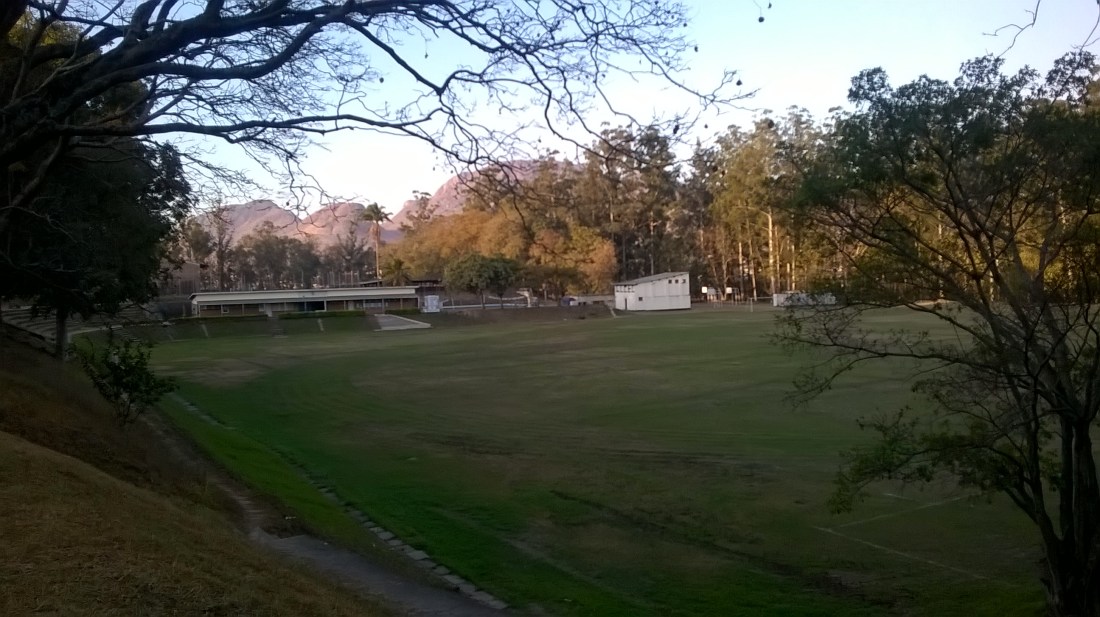
Can this be my man?

Dad & P

Within days, if not hours, of arriving in Malawi a new style Steve began to reveal himself to the children and I.

We had become accustomed to the man in our lives being rather grumpy, preoccupied and irritable. We were used to him seeming tired…all the time. We knew it wasn’t his fault. He couldn’t help it when his drive home from school took an hour or more. He couldn’t help it when he had yet more recruitment issues in his faculty and he didn’t know who would be standing in front of his classes the next day. He couldn’t help it when he had to bring in more monitoring strategies; when he knew he would look like the bad guy and he desperately didn’t want to. I’m sure most of his colleagues knew that he is a genuinely nice person, but he had been cornered into this policing role that definitely did not suit him – his character or his leadership style.

The more uncomfortable he felt at work, the more work sucked the vitality out of him and ballooned to fill every space in his mind, whether at work or at home.

I was sympathetic to Steve’s situation; as a teacher myself I knew what was happening in our schools and I understood implicitly the horrendous circumstances that had not given him a good first year in the job:

In September Steve started at his new school.

In October we lost his Mam to cancer.

And Steve’s second in department went on maternity leave.

In November I had Ofsted.

In December (the following week) we moved house.

In February I had Piran.

In March Steve’s Dad was diagnosed with cancer.

In April our house was burgled.

In July and August we spent every available day with Steve’s Dad in Northumberland, mostly in hospital.

In September we lost him.

To that backdrop, how is anyone meant to make their mark as a leader in Sciences with 16 members of staff? Or improve the performance of students across qualifications? Or complete all the necessary administration and exam entries? Or plan lessons and mark books? Or stay awake on the lengthy commute? Or even…drag yourself out of bed every morning and go to work? He didn’t take a single day off sick. Not one.

For all this and so much more, we admired and adored him: me, my husband; Izzy and Piran their Daddy. He never became less important to us, but at times his arrival home brought with him a dark cloud, that overshadowed us all. Our family life had lost its joy.

I am not saying that for 5 years our life was joyless – of course not. Have you met our children? Or me? There was plenty of joy and laughter, but there was much more during school holidays than term time! We still saw friends and visited family. We still played games and watched funny things on TV. And we went for walks in the countryside and took the kids to the park. But fun seemed to take a lot of effort.

Now, in Malawi, the same family unit of four, it appeared that more had changed than our location. Steve was at ease, relaxed, smiling even. He seemed truly happy. When we went anywhere, it would be Steve, not me, greeting people. He would explain to me the importance of greetings in this part of Africa. It’s not OK to launch in to what you are looking for or what you need, without first saying hello and asking after the person’s health, and possibly their family’s health. Once that is done, and only then, can you go on to where you would begin in England. Steve was familiar with this process from his time in Botswana and he enjoyed it. No longer reticent to start a conversation or embark on chitchat, he was making the first social moves (and would later negotiate calmly at border crossings) and causing me to stand speechless with surprise beside him!

But I like this new Steve. I like his calm demeanour. I like the glint in his eye. I like to see him joking with the children. And I like the attention we are now used to. Somehow (I’m not sure how this works), this enchanting land of wonderful wildlife and acacia trees, of huge skies and red sunsets, has made my husband feel that he belongs, like nowhere else on earth has done. Here he is at one with the landscape and at peace with himself.
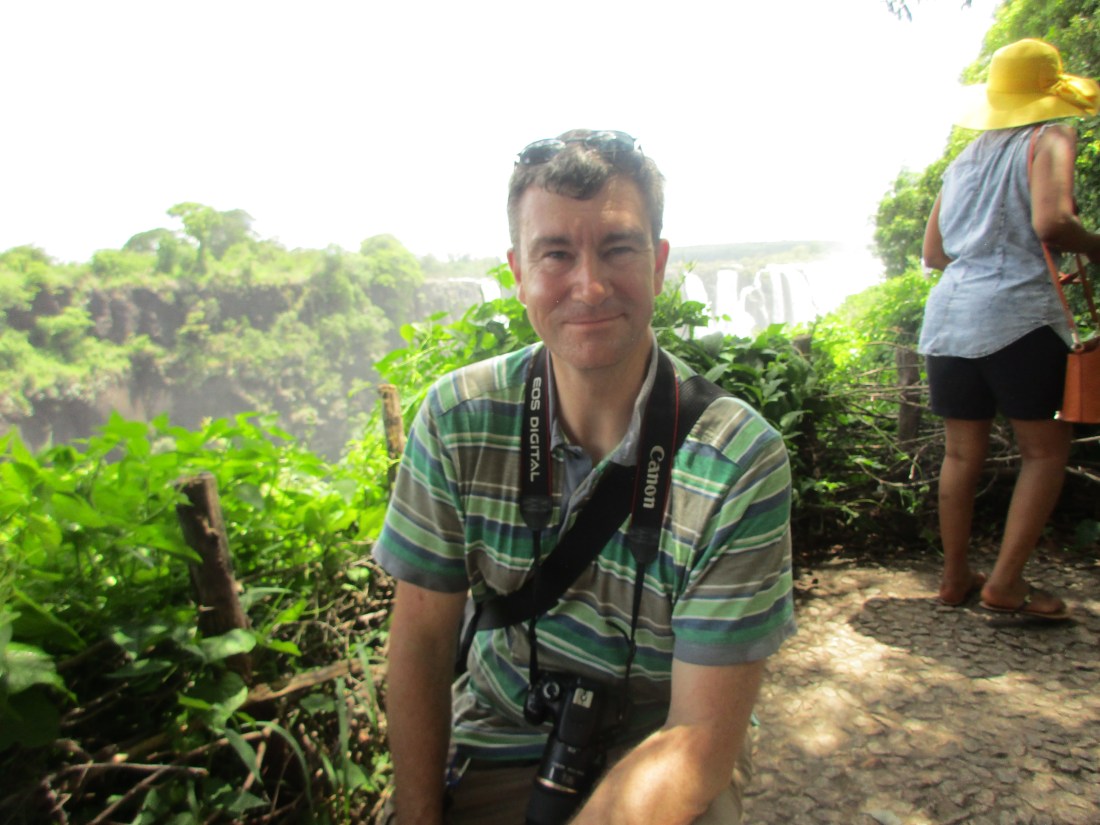
Steve Vic Falls

The French have a fabulous word for this, like a blossoming, an opening out, a revelation: un épanouisement.

[On a vécu au Malawi un ëpanouissement énorme dans la famille Harrison.]


What is school like Term 1?

I came across some musings I had written in a journal when we had been here just a few weeks and I’m glad I found them – I honestly cannot remember what our first impressions were; 3 years here have totally influenced how we view our life in Blantyre. This is what I wrote;

“We’ve been here 5 weeks now and it’s flown. The children are settling well at their new school, despite some ‘blips’. They are doing amazingly well, actually.

Steve began his Senior Teacher work almost immediately after landing, but he is enjoying it. What is even better, is seeing his confidence coming back already, with his enjoyment of the new job. I can recognise my ‘Cotswold School’ Steve again; the one I fell in love with over a decade ago; only this time is even better because this is ‘Steve in Africa’ and I have never seen this side to him before. [What’s more, unlike Botswana, Steve is in Malawi with his wife beside him and two happy children running around the garden!] He is starting to believe that he can do a very good job in this role, alongside the others on SLT and the self-esteem eroded by the previous job, is starting to return.

As for me, I am happy here. I enjoy family life, with Jeffrey helping in our home and Francis in our garden. I am doing a little bit of teaching, covering for absent colleagues the first week of term, and now teaching one Year 8 French and one Year 13 Business class (the Deputy Head was short of a teacher in these two departments, the ones I happen to have a degree in!) One 70-minute lesson per day is keeping my mind occupied and my identity as a teacher satisfied – to have a small role outside the home. I had worried that I would experience boredom, coming out here without paid work for the first time in my adult life, but I seem to always be busy (I find that small tasks I expect to complete quickly can take me half a day, or a whole day, or even several days together – everything happens at a slower pace here: there is no rush).

When the children are at school, I am taking an online course in Mindfulness through Monash University and I am finding it very interesting. How to ensure that you are really ‘present’ and aware of each moment? The meditations and exercises in self-compassion are very helpful; as a person who has always had very high expectations of self and others (unreasonably/unhelpfully so), it is really benefiting my psyche and my marriage. The children and I are even finding time to meditate together; we might light a candle, talk about a story or listen to a song, share our thoughts or worries, then pray together – it’s a lovely way to bring family far away into our home, to remember them together in what we are calling our ‘Sacred Space’.

And I am enjoying spending more time with the children and as a family. I have the time to be there for Izzy and Piran, to listen, to play, to just ‘be together’ without so much rushing around. We enjoy campus living; having neighbours we actually see; the children have playmates on tap – they can play without arranging ‘playdates’ days in advance and without any chauffeuring required. The children are all safe within a gated compound where they can walk to friends’ houses alone – it feels like giving them the kind of childhood we enjoyed in 1970s/1980s England.

The children’s new school, Phoenix International Primary School, being international, had children from many different countries. Their classes were small; about half the size of their classes in England. In fact the two schools could hardly be more different! There were contrasts in size and wealth and curriculum (Rowanfield was twice as big with 50% free school mealers and driven to maintain its 3 times Ofsted ‘Outstanding’; Phoenix is fee-paying, smaller and intimate, with the freedom to build the curriculum of its choosing, without inspection) . Phoenix is made up of two halves, called Lower School and Upper School. Each is based around an intimate courtyard, with classrooms coming off and with pillars, plants, play areas and trees all adding character and charm. We were very impressed with the school pool too.

03000865030008a503000af303000c05

As October approached, the incredible Jacaranda came into bloom and filled the school with purple blossoms – breath-taking beauty I had never before beheld. Then to my amazement, as the lilac petals were beginning to fade, they were overlapped by the vibrant, vivid reds of Flame Trees – both a treat to behold. And as we were struck by the warmth of these October colours, so the warmth of new friendships struck us also. Truly, we were living in the ‘Warm Heart of Africa’.


What were our first impressions of Blantyre (Malawi, not Scotland)?

Looking back nearly 3 years, it is difficult to remember our first impressions of Blantyre. The city is concrete grey, with few historical buildings and little ancient charm. The roads are full of cars and lorries that would not pass their MOT back home. On every small trip you pass broken down vehicles, abandoned at a junction or on the highway. Usually instead of red warning triangles, branches are laid in the road.


However, I do remember being pleasantly surprised by our first trip to Chichiri Mall; not that it is a ‘mall’ in the way that most people would understand the word, but the supermarket did have most of the things you would hope for – not cheap, mind, but at least we would be able to get hold of most things. We were taken to two fabulous oases early on: Caffe Grazia and La Caverna @ Mandala House – both serving yummy Italian treats in very scenic surroundings. I had no idea before moving here that there would so many European communities; 4th generation Italian and Greek families.
Similarly, most of the small shops on the main roads (Haile Selassie Avenue, Glyn Jones Road and Victoria Avenue) are run by Indian families; families who have been here for decades; some have come here via the UK and have ties to all three countries. A huge advantage of this for expatriates is the presence of 2 good Indian restaurants in town…we were looking forward to trying them out. It’s hard to describe the little shops in the town centre – they are not always recognisable by the shop name and the eclectic mix of goods inside do not always help decipher the nature of the business. Much of their wares appear to come from China and very few brands are familiar to us. Yet, some of these businesses are invaluable – Citipharm is indispensable to us already and certain goods we could old purchase from Citi Boutique.
A down side of shopping in Blantyre centre is the prevalence of beggars and the ethical dilemmas posed by them. There were beggars on the pavements, beggars by the cars at major junctions and hawkers everywhere trying to sell everything from mops to oranges to sunglasses and car chargers. It seemed there is no limit to the number of times you can say, ‘No, thank you’ in the space between the car and the shop door (I desperately wanted to learn to say these things in Chichewa)!
I say, ‘the car’ and not, ‘our car’ because we did not yet have a car and were busy hunting for the right vehicle. In the meantime, we were dependent on colleagues and neighbours who could squeeze us into their car or lend us their car when they were not using it. It was understandably frustrating not being able to get around under our own steam. I’ve since discovered an amazing taxi driver, who I use whenever our car is with the mechanic – I wish I’d had his number back in 2015! But friends really were very kind and helpful.
I’ve mentioned wanting to learn the language, but it was also amazing to realise that everywhere we went in Blantyre people were perfectly able to communicate with us in English; Malawi really does have a very high standard of English and comes top 10 in Africa every year for the quality of English spoken. We felt very lucky in that regard.
On my second Sunday here, I got the chance to climb Ndirande mountain with some of the SAIntS teachers. We set off early to avoid the midday sun. It was a great morning; partly because I got to know some lovely colleagues better; partly because I always think that climbing a mountain helps you to orientate. There is no better way to gain perspective than seeing the landscape change and the city below become smaller as you climb. There were a few tricky rocks to clamber over (with help from a young DT teacher) but the view from the summit was well worth the effort. And I’ve enjoyed the view of Ndirande from the school all the more for knowing that I have conquered it!

WP_20150816_033
Our final significant experience as part of our orientation was the day trip to Majete National Park; we drove down the escarpment down into the Chikwawa valley, descending around 1000 metres, feeling the sun get hotter as we approached Majete. No sooner than we were through the gates, than we began to see antelope – antelope that feel very familiar to me now but whose names I had never even heard until that eye-opening day in August. We saw little impala, bigger nyala and waterbuck, impressive sable and kudu, along with the ever comical warthog and guinea fowl. The big question on our lips was, “will we see elephant?” We needn’t have worried – down by the Shire (pronounced Shi-ree) river, early in the day, we spotted a family of five elephant, one a baby. I was surprised by my reaction; my eyes filled to see elephant in the wild for the first time – so big, so majestic – I was speechless. That was the first but not the last time elephant have moved me to the core. They really are very special creatures – a wonder to behold. What a privilege!


It would be fair to say that our first impressions were many and varied. Blantyre was many different things at different times, in different places and with different people. We knew already that Malawi held a charm that would captivate us for years to come. There would be struggles along the way, but the benefits already becoming perceptible to us, we felt sure, would make every uphill climb worth its effort.